1 min to read
Meta-learning for Stress Testing and Selective Forecasting and Graph-based Synthetic Time Series Generation
[Presentations on the 13th May 2026, A.5.1]
On the week of the 13th of May we will have not one, but two presentations. Ricardo Inácio and Luís amorim from FEUP will join us to discuss their work.
Meta-learning for Stress Testing and Selective Forecasting (by Ricardo Inácio)
Forecasting models can fail unexpectedly when time-series characteristics conflict with their inductive biases, even if the data is not anomalous. My work explores stress testing approaches such as MAST, which extract statistical and frequency-domain features to identify and explain conditions that degrade forecasting performance. I will show how past performance and data characteristics can be used to predict high-risk forecasts ex ante and enable selective abstention from unreliable predictions.
Graph-based Synthetic Time Series Generation (by Luís Amorim)
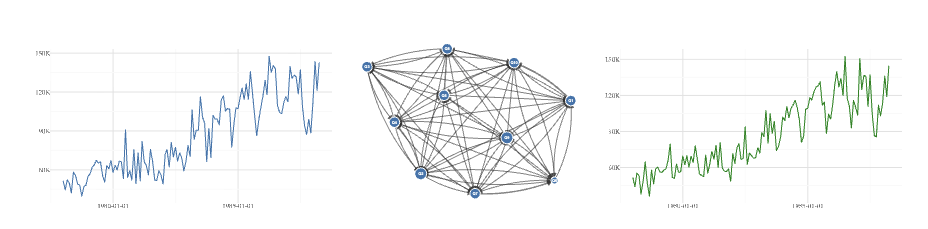
Synthetic time series are increasingly important for improving forecasting models when real-world datasets are scarce. This work explores Grasynda, a synthetic data generation method that converts time series into graph structures, representing states as nodes and temporal transitions as directed edges. We use the transition probability matrices to encode the generation process and then create time series that preserve temporal dynamics.


Comments